MTL vs DTL: Which Pod Kit Suits Your Draw

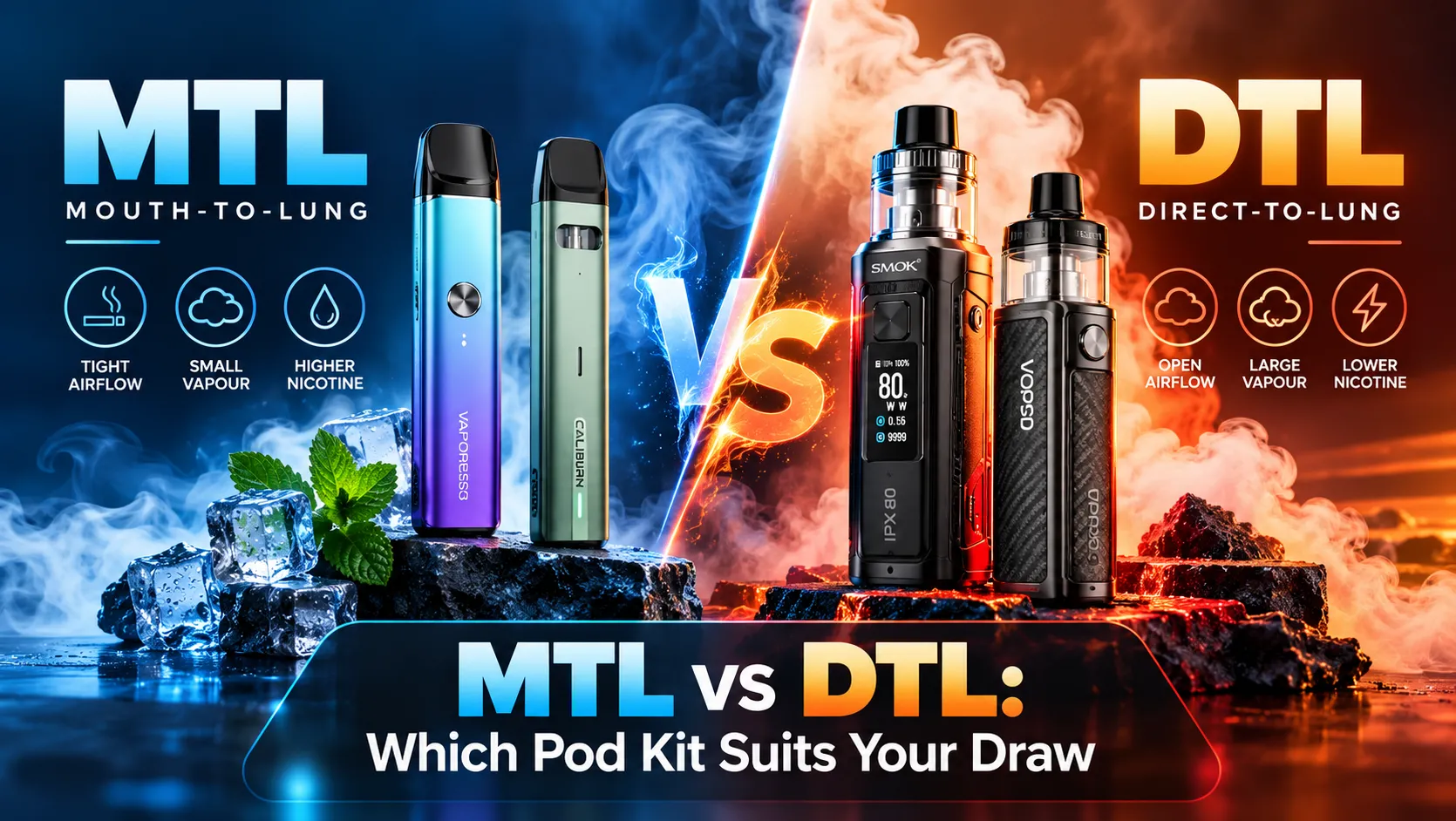
MTL means mouth-to-lung: you draw vapour into your mouth first, then inhale it, exactly as you would smoke a cigarette. DTL means direct-to-lung: you draw straight into your lungs in one motion, as you would through a wide straw. Three specifications decide which one a device gives you — coil resistance, wattage and airflow — and they move together.
Getting this wrong is the most common and most expensive mistake in buying a first pod system kit, because a device built for the wrong draw is not merely disappointing — it is unusable. This page explains how to tell which you want before you spend anything.
Quick summary
- MTL: coil resistance above roughly 0.8 Ω, 10–25 W, tight airflow. Small vapour, cigarette-like draw, pairs with higher nicotine strengths.
- DTL: coil resistance below roughly 0.5 Ω, 40 W and up, open airflow. Large vapour, warm draw, requires low nicotine strengths.
- RDTL sits between them — around 0.6 Ω at 25–40 W, a restricted lung draw that suits people moving on from MTL.
- Nicotine strength is not a free choice. High-strength salt nicotine in a DTL device delivers far too much nicotine per puff. The two decisions are linked.
- If you are coming off cigarettes, you want MTL. Almost without exception.
What the Two Draws Actually Feel Like
Mouth-to-lung is a two-stage action. You pull vapour into your mouth against noticeable resistance — the airflow is deliberately tight — hold it briefly, then inhale. The draw is cool, the vapour volume is small, and the sensation in the throat is sharp rather than warm. It is the motion every cigarette smoker already has.
Direct-to-lung is one continuous motion. Air passes with almost no resistance and you inhale straight into the lungs. The vapour is warm and voluminous, the throat sensation is soft and full rather than sharp, and a single draw delivers several times as much vapour as an MTL puff.
People do not usually find DTL “better” or “worse” — they find one of them natural and the other actively unpleasant. Someone used to MTL who tries a DTL device typically coughs; someone used to DTL who tries MTL finds it stifling and unsatisfying.
The Three Specifications That Set the Draw
Every device published specification tells you which draw it produces, if you know which numbers to read.
| Specification | MTL | RDTL | DTL |
| Coil resistance | 0.8 – 1.6 Ω | 0.5 – 0.8 Ω | 0.1 – 0.4 Ω |
| Typical wattage | 10 – 25 W | 25 – 40 W | 40 – 100 W |
| Airflow | Tight, restricted | Partly open | Wide open |
| Vapour volume | Small | Moderate | Large |
| Draw temperature | Cool | Warm | Hot |
| Suits nicotine | 20 mg/ml salt | 10 – 20 mg/ml | 3 – 6 mg/ml freebase |
| Liquid consumption | Low | Moderate | High |
Resistance is the single most reliable indicator, because it is printed on every coil and pod. A number starting with 0.8 or higher means MTL. A number starting 0.1 to 0.4 means DTL. The bands in between are transitional.
The reason resistance governs everything is straightforward electrical behaviour. A lower-resistance coil passes more current at the same voltage, so it heats a larger surface area and vaporises more liquid per second. More vapour needs more air to carry it, which is why low-resistance coils always come with wider airflow — the two are designed together, not chosen independently.
Why Nicotine Strength Is Part of the Same Decision
This is the part buyers most often miss, and it matters more than the hardware.
Your nicotine intake per puff is roughly the strength of the liquid multiplied by how much liquid the device vaporises. A DTL device vaporises several times more liquid per draw than an MTL device. So the same 20 mg/ml liquid that feels correct in a 1.0 Ω MTL pod delivers a much larger dose through a 0.2 Ω DTL coil.
| Draw style | Liquid type | Typical strength | What happens if you mismatch |
| MTL | Nicotine salt | 10–20 mg/ml | Too low a strength feels unsatisfying, so you vape more to compensate |
| RDTL | Salt or freebase | 10–20 mg/ml | Workable across a wider range than either extreme |
| DTL | Freebase | 3–6 mg/ml | High-strength salt at 60–80 W delivers far more nicotine per puff than intended, and is harsh |
Under clause 4.2.4 of UAE.S 5030:2018 nicotine in e-liquid is capped at 20 mg/ml, which is the standard strength for salt nicotine designed for MTL devices. Lower-strength freebase e-liquids at 3 to 6 mg/ml are what DTL devices are built around.
The practical rule: if you want to keep using higher-strength liquid, you want an MTL device. Buying a high-wattage kit and filling it with 20 mg/ml salt is the most common way people end up with a device they cannot tolerate.
How to Tell Which You Want
You do not need to try both. Three questions settle it.
- How do you currently inhale? If you smoke cigarettes or use a small disposable, you already draw mouth-to-lung. Switching draw style and device at the same time makes the change harder than it needs to be.
- Do you want to be discreet? MTL produces a small amount of vapour that dissipates quickly. DTL produces a visible cloud. In the UAE, where vaping is not permitted in many indoor and public spaces, this is a practical consideration rather than a stylistic one.
- How much are you willing to spend on liquid? A DTL device gets through several times more e-liquid than an MTL one for the same number of draws. That is the largest ongoing cost difference between the two, and it compounds every month.
If the answers are “cigarettes”, “yes” and “as little as possible”, you want MTL — which is the case for most people making the switch. If you have vaped for a while, want volume and warmth, and are comfortable at 3 to 6 mg/ml, DTL is the direction.
What About Devices That Do Both?
Many kits ship with two coils of different resistances and adjustable airflow, and are marketed as covering both styles. That claim is broadly true but worth qualifying.
A device with a 0.6 Ω and a 1.0 Ω coil genuinely spans MTL and restricted DTL, and switching between them is a real change in draw. A device with 0.15 Ω and 0.3 Ω coils spans two flavours of DTL — both are open, high-power draws, and neither will feel like a cigarette however tightly you close the airflow.
So read the resistance range rather than the marketing. If the highest resistance offered is below 0.5 Ω, the device does not do MTL, whatever the listing says. And note that a dual-style device usually means buying both coil types and a second pod, which the headline price does not include.
Frequently Asked Questions
What does MTL mean in vaping?
Mouth-to-lung: drawing vapour into the mouth first, then inhaling it, the way a cigarette is smoked. MTL devices use coils above roughly 0.8 Ω at 10 to 25 W with tight airflow, producing a small amount of cool vapour and a sharp throat sensation.
What does DTL mean in vaping?
Direct-to-lung: drawing vapour straight into the lungs in one motion, through wide-open airflow. DTL devices use coils below roughly 0.4 Ω at 40 W and above, producing large volumes of warm vapour and consuming several times more e-liquid per puff than MTL.
Which is better for quitting cigarettes, MTL or DTL?
MTL matches the inhalation pattern a smoker already has, which is why it is the usual starting point when switching. It also uses far less e-liquid and pairs with the 20 mg/ml salt nicotine that UAE.S 5030:2018 permits. These products are not smoking-cessation treatments and are not marketed as such.
How do I know if a pod kit is MTL or DTL?
Read the coil resistance. Anything from 0.8 Ω upward is MTL, 0.5 to 0.8 Ω is restricted direct-to-lung, and 0.1 to 0.4 Ω is DTL. Wattage confirms it: 10 to 25 W is MTL territory and 40 W upward is DTL. Airflow follows the coil rather than the other way round.
Can I use 20mg salt nicotine in a DTL device?
You can physically, but it delivers far more nicotine per puff than intended and is usually harsh and unpleasant. DTL devices vaporise several times more liquid per draw, so they are built around 3 to 6 mg/ml freebase liquid. Match the strength to the device.
What is RDTL?
Restricted direct-to-lung — a lung inhale through partly closed airflow, typically around 0.5 to 0.8 Ω at 25 to 40 W. It sits between the two main styles and suits people who find MTL limiting but do not want full DTL vapour volume or the low nicotine strengths it requires.
Does DTL use more e-liquid than MTL?
Considerably more. A low-resistance coil at high wattage vaporises several times the liquid per draw that a high-resistance coil at 15 W does. Over a month that is the single largest cost difference between the two styles, and it usually outweighs any difference in device price.
Can one pod kit do both MTL and DTL?
Some can, if the coil range spans both — a kit offering 0.6 Ω and 1.0 Ω genuinely covers MTL and restricted DTL. But a kit whose highest resistance is below 0.5 Ω only does DTL, regardless of how it is described. Check the resistance range rather than the marketing claim.
Delivery cut-offs are on the delivery page, with age verification on every order.
These products contain nicotine, which is addictive. For sale to adults aged 18 and over only. Not for use by non-smokers, pregnant or nursing women, or people with heart or lung conditions. Nothing on this page is a health claim, and these products are not smoking-cessation treatments. Resistance, wattage and strength bands describe conventional industry practice and the specifications published by the devices stocked here; they are guidance for selection, not measured results. Nicotine limit from UAE.S 5030:2018, clause 4.2.4. Last updated: 6 September 2026.