
Do Nicotine Pouches Stain Teeth or Affect Gums?

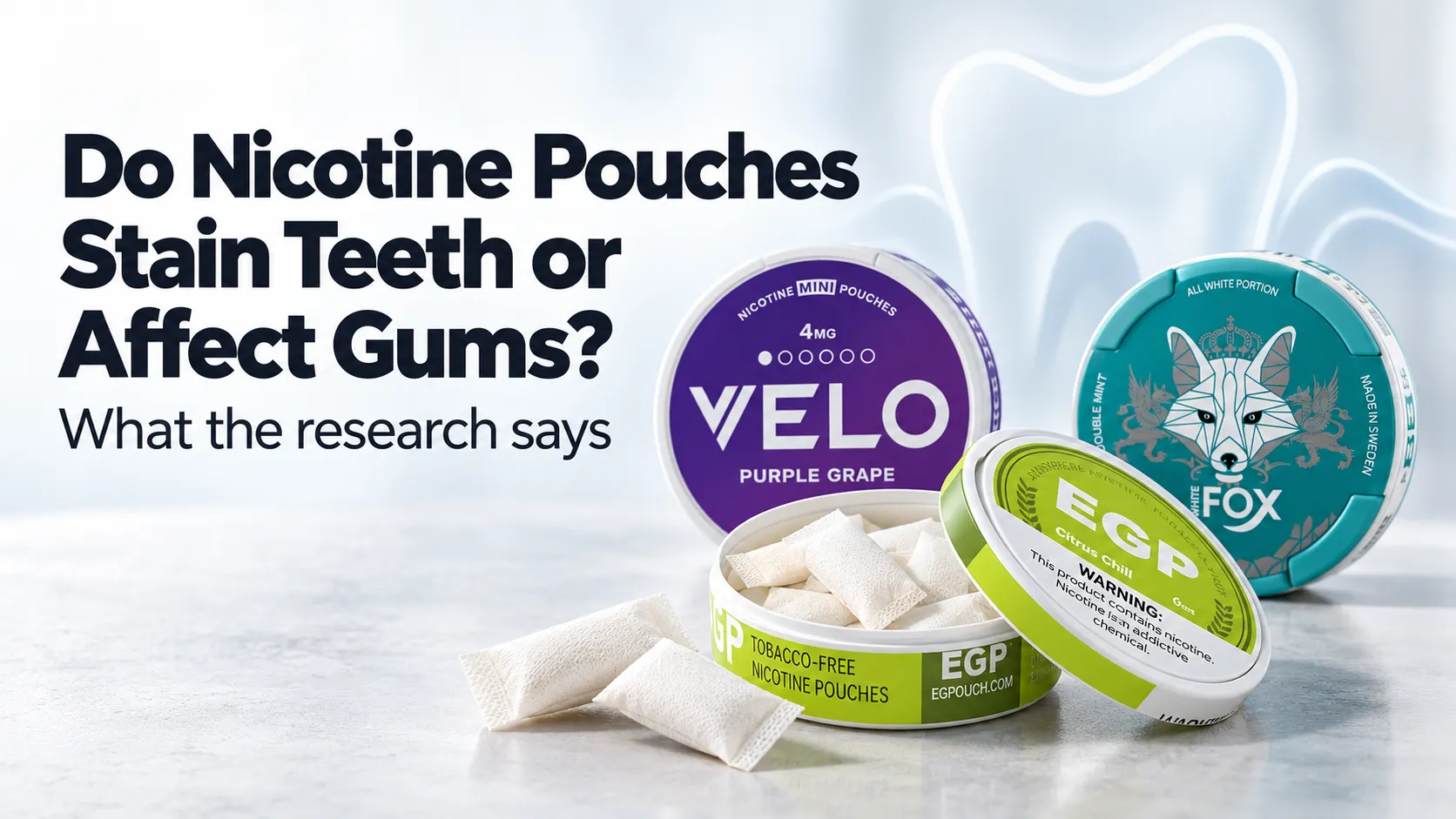
On staining, there is no published study measuring tooth discolouration from tobacco-free nicotine pouches — the question most people ask has not been directly researched. On gums, there is evidence: a 2026 cross-sectional study of 272 young adults found oral lesions in 79% of nicotine pouch users, and published case reports describe gum recession at the exact sites where pouches were habitually placed.
This page sets out what the peer-reviewed literature reports, and is explicit about where it stops. It cites only published research, not manufacturer material or retailer commentary.
Quick summary
- Staining has not been studied. No peer-reviewed research measures tooth discolouration from tobacco-free pouches. Absence of evidence is not evidence of absence.
- Oral lesions are common in users. Daneshian et al. (2026) found lesions in 79% of nicotine pouch users and 89% of tobacco-pouch users, with erythema more frequent in the nicotine pouch group.
- Users reported more oral symptoms than those using tobacco-derived pouches, despite the lower overall lesion rate.
- Recession has been documented at placement sites. Two case reports describe gum recession, and in one case leukoplakia, precisely where pouches were repeatedly placed.
- No increased caries or periodontal disease risk was observed in that study with up to six years of use.
On Staining: The Evidence Does Not Exist
The most-searched question about nicotine pouches has not been answered by research. We searched the published literature for studies measuring tooth discolouration from tobacco-free pouches and found none. The largest clinical study of pouch users to date examined oral lesions, gingival recession, caries and periodontal status — staining was not among the reported outcomes.
What circulates online instead is a mechanistic argument: pouches contain no tobacco leaf and involve no combustion, so they lack the tar and the combustion by-products that stain teeth in smokers. That reasoning is sound as far as it goes. It is not the same as a measurement, and it does not account for the flavourings, sweeteners and colourants a pouch does contain, or for prolonged direct contact between the pouch and the tooth surface.
So the honest answer is that nobody has measured it. Anyone telling you pouches definitely do not stain teeth is reasoning from mechanism, not citing data — and we are not going to do that either.
On Gum Tissue: What the Research Reports
The cross-sectional study
The most substantial evidence comes from Daneshian, Fredriksson, Skott and Garming Legert, published in Oral Diseases in 2026 (DOI 10.1111/odi.70409). It is a cross-sectional study following the STROBE checklist, recruiting 272 participants aged 18 to 30 from nine dental clinics: 126 nicotine pouch users, 63 users of oral tobacco-derived pouches, and 83 non-users.
| Finding | What the study reports |
|---|---|
| Lesion prevalence | Oral lesions in 79% of nicotine pouch users, against 89% of oral tobacco-derived pouch users |
| Lesion type | Erythema more frequent in nicotine pouch users; hyperkeratosis predominated in the tobacco-pouch group |
| Symptoms | Nicotine pouch users reported more oral symptoms |
| Caries and periodontal disease | No increased risk observed with up to six years of use |
| Flavour | A non-significant trend suggested mint-flavoured pouches may be associated with more pronounced lesions |
The authors’ conclusion, quoted directly: “Nicotine pouches appear to induce broader mucosal responses than tobacco-containing snus.” They add that “further research is needed to clarify local and systemic effects.”
Two points of interpretation matter here. The 79% figure describes the proportion of users in whom lesions were found; the published abstract does not report the corresponding rate in the 83 non-users, so the figure should not be read as the proportion caused by pouches. And a cross-sectional design captures a moment in time — it establishes association, not causation.
The case reports
Separately, Alkhatib, published in BMC Oral Health in 2025 (volume 25, article 2004), describes two cases. A 22-year-old man who had used pouches daily for 11 months, consistently in the same buccal sites, presented with isolated gingival recession and localised leukoplakia at the maxillary canines. A 25-year-old man with 18 months of daily use presented with recession on the buccal aspects of three teeth, again mainly at the sites where he placed pouches.
The author notes that the lesion distribution corresponded “precisely” to the habitual placement sites. He also states the limitations plainly: the leukoplakia was not biopsied, baseline images were missing, both patients were lost to or incomplete at follow-up, and the causal link is therefore not established.
Two cases cannot tell you how common something is. What they do show is a pattern worth knowing about — tissue change concentrated exactly where the pouch sat, in users who placed pouches in the same spot every time.
What This Means in Practice
The research does not support a reassuring summary, and it does not support an alarming one either. What it supports is specific:
- Tissue changes at the placement site are documented, both as common findings in a clinical sample and as individual case reports of recession.
- Repeated placement in one spot appears in both case reports. Rotating where you place a pouch is a reasonable response to that pattern — the usage guide covers placement.
- Mint flavours showed a non-significant trend towards more pronounced lesions. Non-significant means the study could not rule out chance; it is a signal for further research, not a finding.
- Caries and periodontal disease showed no increased risk in that sample at up to six years of use. That is a genuine negative finding and worth stating as precisely as the positive ones.
- Longer-term data does not exist. These products are recent, and no study yet covers decades of use.
If you notice persistent soreness, white patches, bleeding or visible gum recession where you place pouches, that is a matter for a dentist rather than a web page. None of the above is a diagnosis or a substitute for clinical advice.
Why the Pouch Contacts Tissue the Way It Does
Pouches contain a pH regulator — usually sodium carbonate — because nicotine is only absorbed through the oral mucosa in its alkaline freebase form. That raises the pH of the material held against the gum for 20 to 30 minutes at a time.
UAE.S FDS 5061:2024, the Ministry of Industry and Advanced Technology standard covering tobacco-free oral nicotine pouches, sets a maximum pH of 9.1. The composition and the chemistry are set out on the ingredients page.
We are describing a mechanism, not asserting that it causes the findings above. The studies cited report what was observed; they do not establish why.
Frequently Asked Questions
Do nicotine pouches stain teeth?
No published study has measured tooth discolouration from tobacco-free nicotine pouches, so there is no evidence either way. The common argument that they do not stain rests on the absence of tobacco and combustion rather than on measurement, and it does not account for flavourings, sweeteners or prolonged contact.
Do nicotine pouches cause gum recession?
Two case reports published in BMC Oral Health in 2025 describe gingival recession at the exact sites where users had placed pouches daily for 11 and 18 months. The author states that the causal link is not established. Case reports show a pattern; they cannot establish how common it is.
What do studies say about nicotine pouches and oral health?
A 2026 cross-sectional study in Oral Diseases of 272 adults aged 18 to 30 found oral lesions in 79% of nicotine pouch users and 89% of oral tobacco-derived pouch users, with erythema more frequent among nicotine pouch users, who also reported more oral symptoms.
Are nicotine pouches linked to gum disease or cavities?
In the 2026 study, no increased risk of caries or periodontal disease was observed among nicotine pouch users with up to six years of use. That is a specific negative finding in one sample over that period, not a general statement about longer-term use.
Can nicotine pouches cause white patches in the mouth?
One of the two published case reports describes localised leukoplakia — a white patch — at a habitual placement site in a 22-year-old after 11 months of daily use. It was not biopsied, so it was not histologically confirmed. Any persistent white patch warrants a dental examination.
Does the flavour of the pouch make a difference?
The 2026 study reported a non-significant trend suggesting mint-flavoured pouches may be associated with more pronounced lesions. Non-significant means the result could not be distinguished from chance, so it indicates a question for further research rather than an established effect.
Does moving the pouch around help?
Both published case reports involved users who placed pouches in the same site every time, and the lesions corresponded to those sites. Rotating placement is a reasonable response to that observation, though no study has tested whether it changes outcomes.
Is there long-term research on nicotine pouches?
Not yet. Tobacco-free nicotine pouches are a recent product category and the available clinical evidence covers months to a few years of use. The authors of the largest study to date state explicitly that further research is needed to clarify both local and systemic effects.
The Short Version
Nobody has measured whether nicotine pouches stain teeth, so claims in either direction are reasoning rather than evidence. On gums there is published research: lesions were found in 79% of pouch users in a 2026 study of 272 people, erythema was the characteristic finding, users reported more oral symptoms, and no increased caries or periodontal risk was seen at up to six years. Two case reports document recession exactly where pouches were habitually placed. The literature is early, the designs cannot establish causation, and persistent changes in your mouth are a question for a dentist.
Nicotine is addictive. For sale to adults aged 18 and over only, and intended for adults who already use nicotine. Not for use by non-smokers, pregnant or nursing women, or people with heart conditions. Nothing on this page is a health claim and none of these products are smoking-cessation treatments. This page summarises published research for general information. It is not medical or dental advice, does not diagnose, and is no substitute for examination by a qualified dentist. Sources: Daneshian M, Fredriksson L, Skott P, Garming Legert K. Oral Lesions and Dental Status in Individuals Using Oral Tobacco-Free Nicotine Pouches. Oral Diseases, 2026. DOI 10.1111/odi.70409, PMID 42384425. · Alkhatib OA. Localized gingival recession and leukoplakia associated with nicotine pouch use: two clinical case reports. BMC Oral Health, 2025;25:2004. · Regulatory reference: UAE.S FDS 5061:2024. Last updated: 10 October 2026.