
How to Use Nicotine Pouches: First-Time Guide

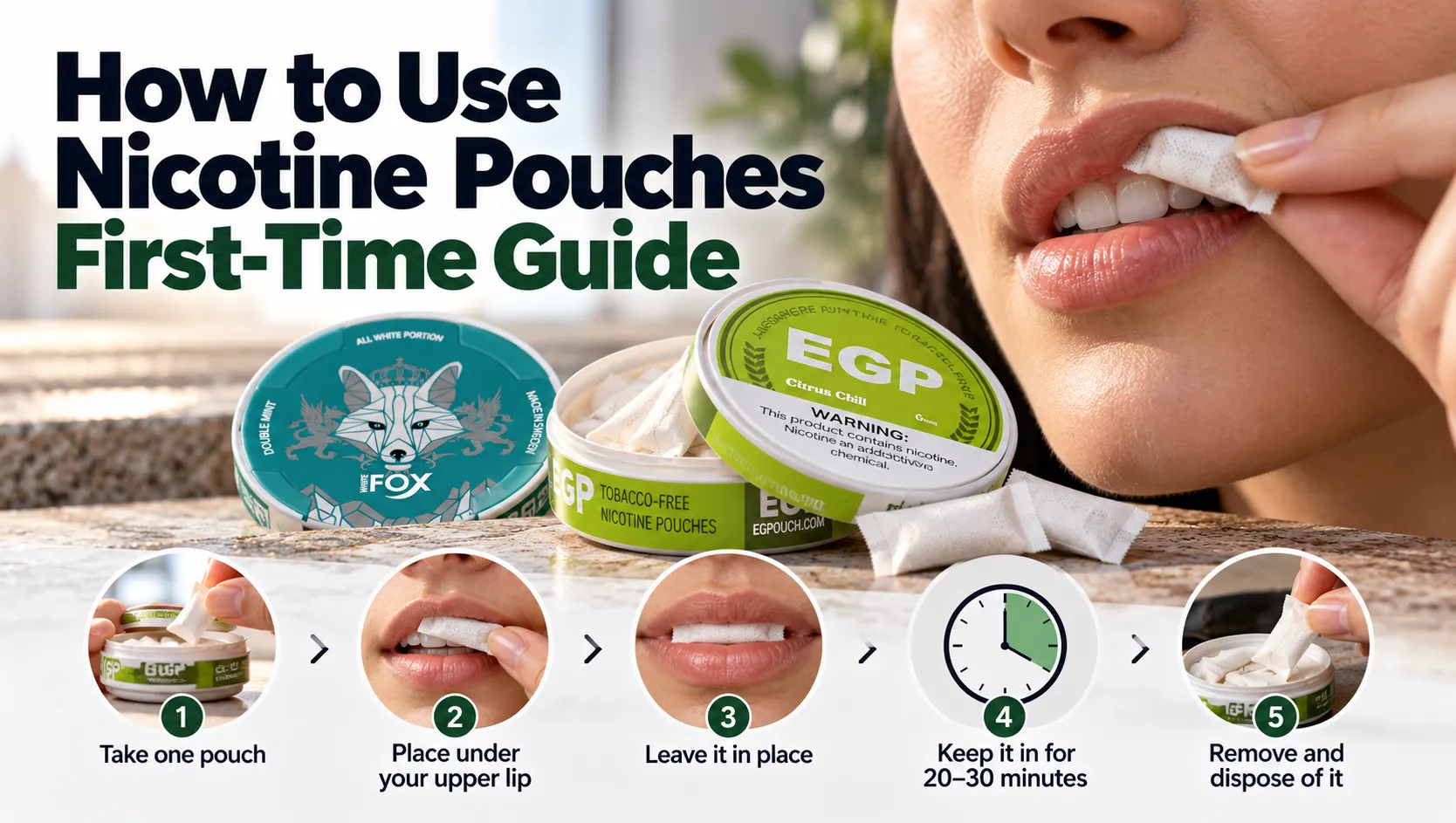
Place the pouch between your upper lip and gum, towards the side of your mouth, and leave it there. You do not chew it, suck it or move it around. A tingling sensation starts within a minute or two and settles — that is normal and it means the pouch is working. Remove it after 20 to 30 minutes and put it in the lid of the can.
That is the whole technique. The rest of this page covers the details that make the first one go well rather than badly, because the most common bad first experience comes from using a pouch like chewing gum.
Quick summary
- Upper lip, to one side. Not under the tongue, not in the cheek pouch, not between the teeth.
- Leave it alone. No chewing, no sucking, no shifting it about with your tongue.
- 20 to 30 minutes is the absorption window manufacturers state. Removing it earlier delivers less.
- Tingling is expected in the first minutes and then fades. A burning that does not settle means take it out.
- Swallow saliva normally. There is no need to spit, unlike with snus.
Step by Step
Step 1 — Open the can and take one pouch
Twist or lift the lid. Cans are child-resistant by law in the UAE, so expect slight resistance. Take a single pouch between finger and thumb. Most cans hold 12 or 20 depending on format.
Step 2 — Place it under your upper lip
Lift your upper lip and slide the pouch flat against the gum, towards the left or right side rather than directly at the front. Flat is the key word — it should lie against the gum, not stand on edge.
The upper lip is the standard placement because the tissue there is well suited to absorption and the pouch stays put without you holding it. Some people prefer the lower lip; it works, but the pouch is more likely to shift when you talk.
Step 3 — Leave it in place
Do not chew it, suck on it or push it around with your tongue. A nicotine pouch is not gum, and treating it like gum is the single most common first-time mistake — it forces the contents out faster than intended and produces a harsh, uneven experience.
You can talk, drink and go about your day with a pouch in. It is not visible to anyone else and produces no smoke, vapour or odour.
Step 4 — Keep it in for 20 to 30 minutes
Manufacturers state an absorption window of roughly 20 to 30 minutes, released gradually across it rather than all at once. That means a pouch is a slow build, not an immediate hit — if nothing much is happening after two minutes, that is the product working as designed.
Taking a pouch out after ten minutes delivers roughly a fraction of what it holds. If you want less effect, that is a legitimate way to get it, but it is a different thing from the pouch being weak.
Step 5 — Remove and dispose of it
Take the used pouch out and put it in the compartment in the top of the can, which exists for exactly this. If your can does not have one, wrap it and bin it. Do not flush it, and do not leave it where a child or pet could reach it — a used pouch still contains nicotine.
What the First One Feels Like
A tingling or prickling sensation where the pouch sits, beginning within a minute or two and easing after five to ten. This is the normal response to the alkaline pouch against the gum, and most people stop noticing it after the first few uses.
A warm or slightly peppery feeling is also common, more so with mint and strong flavours. What is not expected is a burning that keeps intensifying, or pain. If that happens, take the pouch out — either the strength is too high for you or that site has become irritated.
If you feel lightheaded, nauseous or notice your heart racing, remove the pouch. That is the response to more nicotine than you are used to, and it passes. It is also the clearest signal that you have started at too high a strength — which the pouch strength guide covers in detail.
Five Things That Make It Go Better
- Rotate where you place it. Using the same spot every time concentrates contact on one patch of gum. Alternate left and right, and vary the position slightly.
- Start with a shorter session. Ten or fifteen minutes on your first pouch tells you how you respond without committing to a full dose.
- Do not use two at once. Doubling up is not how to get more effect; it is how to get the lightheadedness described above.
- Swallow normally. Pouches are designed for the saliva to be swallowed, unlike snus. You do not need to spit.
- Keep the can closed and out of heat. Pouches dry out, and in UAE summer conditions a can left in a car will deteriorate faster than one kept indoors.
Common Mistakes
| Mistake | What happens |
|---|---|
| Chewing it | Forces contents out at once. Harsh taste, uneven delivery, and the pouch can split. |
| Placing it under the tongue | It moves constantly, dissolves unevenly and is uncomfortable. The upper lip holds it still. |
| Taking it out after two minutes | Almost nothing has been absorbed yet. People conclude the product does not work. |
| Leaving it in for hours | Nothing is left to absorb after about 30 minutes, and prolonged contact irritates the gum. |
| Always using the same spot | Concentrates contact on one area of tissue rather than spreading it. |
| Starting at a high strength | Lightheadedness and nausea, which tends to put people off the format entirely. |
Frequently Asked Questions
Where do you put a nicotine pouch?
Between your upper lip and gum, towards the left or right side rather than the front, lying flat against the gum. The upper lip holds it in place without you having to think about it, and the tissue there suits absorption. Rotate sides between pouches.
How long do you keep a nicotine pouch in?
Twenty to thirty minutes, which is the absorption window manufacturers state. The release is gradual across that period rather than immediate, so removing a pouch early delivers proportionally less of what it holds.
Do nicotine pouches tingle?
Yes, usually within the first minute or two, easing after five to ten minutes. It is the normal response to the alkaline pouch against the gum and most people stop noticing it after a few uses. A burning that keeps intensifying is a reason to remove it.
Do you swallow the saliva with a nicotine pouch in?
Yes. Pouches are designed to be used without spitting, which is one of the practical differences from snus. Swallow normally and carry on as usual.
Can you eat or drink with a nicotine pouch in?
You can drink, and you can talk normally. Eating is awkward because chewing dislodges the pouch, and movement against the gum is what you are trying to avoid. Most people take it out to eat.
Should you chew a nicotine pouch?
No. Chewing forces the contents out all at once, producing a harsh taste and uneven delivery, and can split the pouch. It is the most common first-time mistake. Place it and leave it alone.
How do you dispose of a used nicotine pouch?
Most cans have a compartment in the lid for used pouches. If yours does not, wrap it and put it in a bin. Do not flush it, and keep used pouches away from children and pets — they still contain nicotine.
Can you use two nicotine pouches at once?
It is not how the product is intended to be used, and it tends to produce lightheadedness, nausea or a racing pulse rather than a better experience. If one pouch is not enough, the strength is the thing to look at rather than the number.
The Short Version
Upper lip, to one side, flat against the gum. Leave it there without chewing or fiddling for 20 to 30 minutes, swallow saliva as normal, then put the used pouch in the lid. Expect tingling early on and expect nothing dramatic in the first few minutes — the release is slow by design. Rotate where you place it, and if you feel lightheaded, take it out.
Composition is covered on the ingredients page, and the VELO range lists what is stocked.
Nicotine is addictive. For sale to adults aged 18 and over only, and intended for adults who already use nicotine. Not for use by non-smokers, pregnant or nursing women, or people with heart conditions. Nothing on this page is a health claim, and these products are not smoking-cessation treatments. The 20–30 minute absorption window is as stated by the manufacturer. Sensations described are typical reports rather than clinical findings; individual experience varies. If you have a condition affecting your mouth or gums, speak to a dentist or doctor before using oral nicotine products. Last updated: 10 October 2026.