
Disposable Vape Puff Counts: 2500 vs 10000 vs 30000 vs 50000

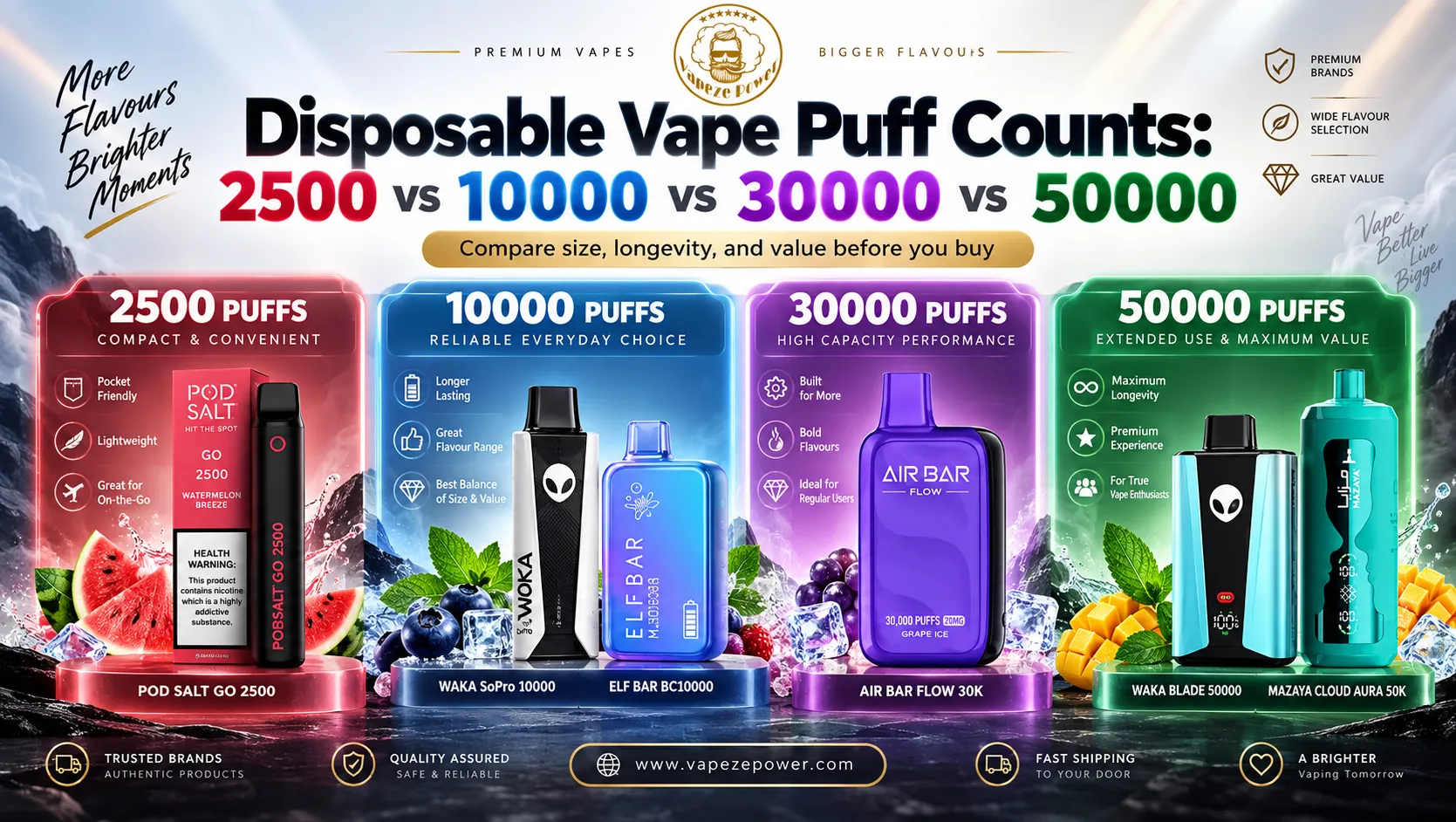
A puff count is the manufacturer’s estimate of how many draws a disposable vape delivers. It is not a regulated measurement, and no UAE or international standard defines how it must be tested. Across the tiers sold in the UAE, a 2,500-puff device holds around 7 ml of e-liquid and a 50,000-puff device holds 33 ml — roughly five times the liquid for twenty times the claim.
That gap is the whole subject of this page. Below is what each tier physically contains, how the tiers compare on liquid per puff, and how to read a puff number on a box before you buy.
| Quick summaryPuff counts are marketing estimates, not regulated measurements. Nothing in UAE.S 5030:2018 defines how they are tested or verified.The four common tiers in the UAE hold roughly 7 ml (2,500 puffs), 18 ml (10,000), 20 ml (30,000) and 33 ml (50,000) of e-liquid.Devices whose claims can be checked consume 2.2–2.8 ml of liquid per 1,000 puffs. The largest tiers imply 0.62–0.90 ml — a fourfold difference the hardware does not explain.Two devices sold side by side both hold exactly 18 ml. One claims 10,000 puffs, the other claims 20,000.Compare capacity in millilitres instead. It is printed on the packaging and it is a physical fact. |
What a Puff Count Actually Measures
A puff count is the number of draws a manufacturer says a device will produce before the e-liquid runs out. It is generated on a test rig that takes draws of a fixed duration, usually two or three seconds, at a fixed power setting, in one continuous session.
Three things follow from that. The figure is not audited by any regulator. There is no agreed draw length, so one brand’s two-second puff and another brand’s three-second puff produce very different totals from the same device. And the test conditions are not how anyone vapes — real draws vary in length, devices sit unused between sessions, and liquid is lost to evaporation and to wicking that never gets vaporised.
This is why the number on the box is the least reliable specification a disposable carries, and why the rest of this page works from capacity instead.
The Four Main Puff Tiers in the UAE
Disposables sold in the UAE cluster into four broad tiers, with the 2,500 and 30,000 tiers being by far the deepest in terms of the number of products available. Here is what each tier is and who it is aimed at.
| Tier | Typical capacity | Rechargeable | What the tier is for |
|---|---|---|---|
| 2,500 puffs | 22 ml | No | Entry devices and flavour testing. Pre-charged, single use, no port. |
| 10,000 puffs | 18–22 ml | Yes (Type-C) | Mid-range. Battery would die before the liquid, so charging is added. |
| 30,000 puffs | 20–30 ml | Yes (Type-C) | High-capacity devices with screens and airflow adjustment. |
| 50,000 puffs | 40 ml | Yes (Type-C) | Largest format. Multi-mode power settings and liquid-level displays. |
Note that the tier name describes the claim, not the hardware. A 30,000-puff device and a 50,000-puff device may use the same coil, the same battery size and the same airflow design. What separates them, physically, is how much liquid the reservoir holds.
How Much E-Liquid Each Tier Actually Holds
The honest way to compare tiers is millilitres of liquid per 1,000 claimed puffs. We calculated that for eleven disposables stocked in the UAE, using each manufacturer’s own stated capacity and its own stated puff count.
| Device | Claimed puffs | Capacity | ml per 1,000 puffs |
|---|---|---|---|
| Air Bar Nano | 800 | 3.2 ml | 4.00 ml |
| Yuoto XXL | 2,500 | 7.0 ml | 2.80 ml |
| Pod Salt GO | 2,500 | 6.5 ml | 2.60 ml |
| Tugboat EVO | 4,500 | 10 ml | 2.22 ml |
| Elf Bar BC10000 | 10,000 | 18 ml | 1.80 ml |
| Vozol Star | 12,000 | 22 ml | 1.83 ml |
| Waka SoPro | 20,000 | 18 ml | 0.90 ml |
| ELFBAR ICE King | 30,000 | 20 ml | 0.67 ml |
| Al Fakher Crown Bar Mega Max | 40,000 | 30 ml | 0.75 ml |
| WAKA Blade | 50,000 | 33 ml | 0.66 ml |
| HOK Clouds HoQa | 80,000 | 50 ml | 0.62 ml |
The pattern is unambiguous, and it runs one way. The four devices at the bottom of the range agree with each other closely, at 2.2 to 2.8 ml per 1,000 puffs. That is the consumption rate you would expect from a mesh coil in a mouth-to-lung device, and it comes from four different manufacturers who did not coordinate their numbers.
From the 10,000 tier upward the figure falls steadily, reaching 0.62 ml per 1,000 puffs at the top. That would mean the largest devices vaporise about a quarter as much liquid per draw as the smallest ones, using the same coil technology at similar power. No published mechanism accounts for that.
The 18 ml Test: Two Devices, Same Capacity, Different Claims
The clearest illustration does not need any modelling at all. Two disposables currently sold in the UAE hold exactly the same volume of liquid.
| Device | Capacity | Nicotine | Claimed puffs |
|---|---|---|---|
| Elf Bar BC10000 | 18 ml | 50 mg/ml | 10,000 |
| Waka SoPro | 18 ml | 50 mg/ml | 20,000 |
Same capacity, same nicotine strength, both mesh-coil draw-activated devices — and one claims to deliver twice as many puffs as the other. Both claims cannot be correct. At minimum, one of the two is testing with a much shorter draw.
This is not a criticism of either brand. It is what happens when a headline number has no defined test method behind it: the figure drifts upward across the market because nothing anchors it.
What the Tiers Deliver If You Apply a Consistent Rate
Applying the 2.2–2.8 ml per 1,000 puffs observed on the lower tiers to the larger devices gives a more realistic expectation of what each capacity supports.
| Capacity | Claimed puffs | Range at 2.2–2.8 ml per 1,000 | Shortfall vs claim |
|---|---|---|---|
| 18 ml | 10,000 | 6,400 – 8,200 | about 20–35% |
| 18 ml | 20,000 | 6,400 – 8,200 | about 60–70% |
| 20 ml | 30,000 | 7,100 – 9,100 | about 70–75% |
| 22 ml | 12,000 | 7,900 – 10,000 | about 15–35% |
| 30 ml | 40,000 | 10,700 – 13,600 | about 65–75% |
| 33 ml | 50,000 | 11,800 – 15,000 | about 70–75% |
| 50 ml | 80,000 | 17,900 – 22,700 | about 70–80% |
This is an internal-consistency check rather than a laboratory measurement: it uses the market’s own low-tier devices as the control group. The conclusion it supports is a modest one, and it is the practical point of this page — a device’s liquid capacity predicts its lifespan far better than its puff rating does, and the gap between the two widens as the claims get larger.
How to Read a Puff Count Before You Buy
Four habits make the number useful rather than misleading.
- Read the millilitre figure first. Capacity is a physical property of the device and every compliant package states it. Treat it as the primary specification and the puff count as a rough class marker.
- Compare within a tier, not across tiers. Two 30,000-puff devices from different brands are comparable to each other because they are marketed against each other. A 30,000 and a 2,500 are not.
- Divide capacity by 2.5. It gives a workable estimate in puffs, and it is close enough for planning how long a device will last before you need another.
- Check nicotine strength alongside capacity. Under clause 4.2.4 of UAE.S 5030:2018 nicotine in e-liquid must be 20 mg/ml or less, and a package marked 5% or 50 mg is above that limit. Clause 4.2.5 also caps an integrated tank at 10 ml.
Puff tiers describe capacity, not quality, and nothing on this page is a recommendation of a particular device. For choosing between products, see the disposable vapebuying guide. For how long a device lasts in day-to-day use rather than in tier arithmetic, see how long a disposable vape lasts. If a device stopped well short of its tier, the early failure guide covers the usual causes. The full nicotine and capacity rules are set out in the UAE vaping laws hub.
Frequently Asked Questions
Are disposable vape puff counts accurate?
Puff counts are manufacturer estimates produced on a test rig, not regulated measurements, and no UAE or international standard defines the test. Devices at the 800 to 4,500 tier use 2.2 to 2.8 ml of liquid per 1,000 claimed puffs, while devices claiming 20,000 or more imply 0.62 to 0.90 ml. The larger the claim, the wider the gap.
What is the difference between a 2500 and a 10000 puff vape?
Capacity and charging. A 2,500-puff device holds around 6.5 to 7 ml of e-liquid, arrives pre-charged and cannot be recharged. A 10,000-puff device holds around 18 ml and carries a USB Type-C port, because its battery would run flat long before the larger volume of liquid was used up.
How many ml is a 30000 puff vape?
Around 20 to 30 ml. The 30,000-puff devices sold in the UAE typically hold 20 ml, while devices marketed at 40,000 puffs hold about 30 ml. Applying the 2.2 to 2.8 ml per 1,000 puffs rate observed on smaller devices, 20 ml supports roughly 7,100 to 9,100 puffs rather than 30,000.
Is a 50000 puff vape better than a 30000 puff vape?
It holds more liquid, which is a real difference: 33 ml against 20 ml. Whether that is better depends on how much you want to carry and how long you want a device to last. The claimed puff figures themselves are not a reliable basis for comparison, because neither is measured to a defined standard.
Why do puff counts keep getting higher?
Because nothing anchors them. With no defined test method and no regulatory verification, the headline figure is a marketing variable rather than a specification, and it drifts upward as brands compete on it. Capacity has risen too, but far more slowly — from around 7 ml to around 50 ml while claims went from 2,500 to 80,000.
What puff count should I choose?
Choose on capacity rather than on the tier name. Divide the millilitre figure by roughly 2.5 to estimate puffs, then match that to how often you want to replace the device. Also check that nicotine strength meets the UAE limit of 20 mg/ml or less before buying, whatever the tier.
Do bigger puff counts mean more nicotine?
No. Nicotine strength and puff count are independent. Among devices sold in the UAE, a 40,000-puff device is available at 6 mg/ml while a 2,500-puff device is sold at 50 mg/ml. Always read the mg/ml figure on the packaging rather than inferring strength from the size of the device.
The Short Version
Puff counts sort disposables into rough classes, and that is all they do reliably. Within the UAE range, 2,500 means about 7 ml, 10,000 means about 18 ml, 30,000 means about 20 ml and 50,000 means about 33 ml — and the relationship between the claim and the liquid weakens steadily as the numbers climb. Read the millilitres, divide by 2.5, and check the nicotine strength against the 20 mg/ml limit.
These products contain nicotine, which is addictive. For sale to adults aged 18 and over only. Not for use by non-smokers, pregnant or nursing women, or people with heart or lung conditions. Nothing on this page is a health claim, and these products are not smoking-cessation treatments.